Syringe Pump
The Syringe page controls the syringe pump used to dispense the deposition solution during coating.
Charon uses an NE-500 syringe pump and can control multiple pumps when more than one pump is installed in the system.
During a typical blade-coating process, the syringe pump delivers the deposition solution to the coating head at a defined flow rate and for a defined volume. The pump can be operated manually from this page or controlled automatically as part of a Charon Recipe.
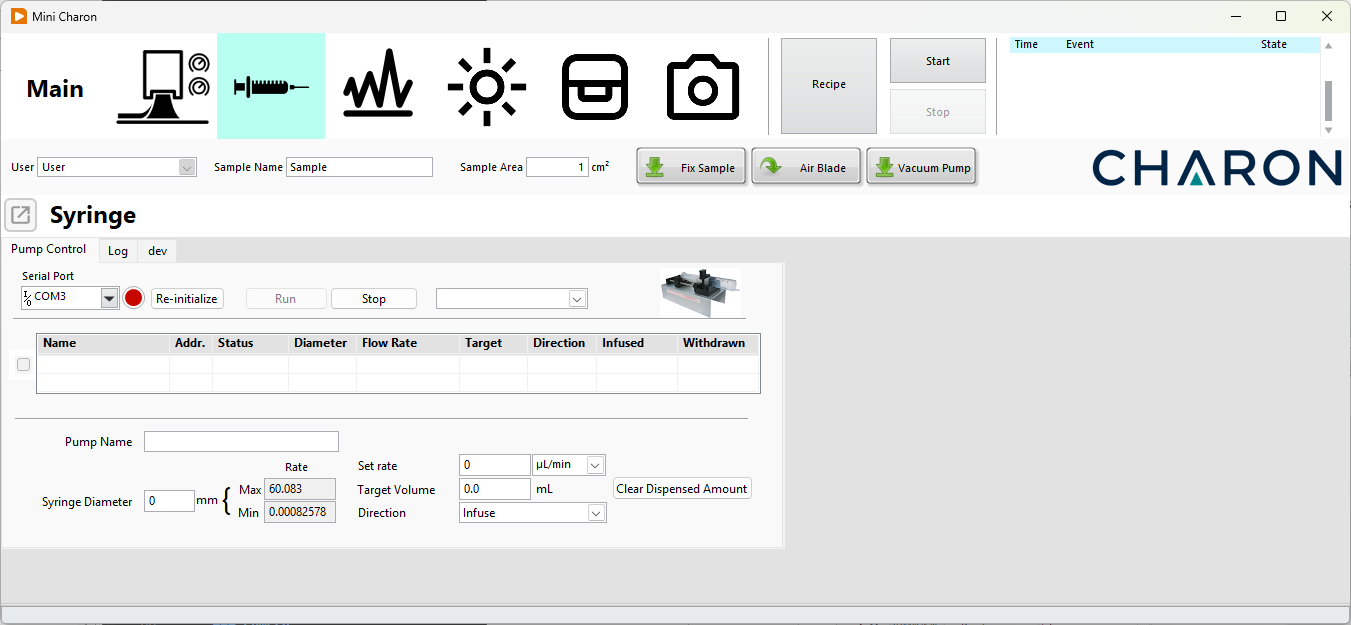
Syringe Pump Overview
The Syringe page provides:
- Real-time monitoring of installed syringe pumps
- Selection of one or more pumps
- Syringe diameter configuration
- Flow-rate control
- Target-volume control
- Infuse and withdraw operation
- Manual Start and Stop controls
- Dispensed-volume monitoring
When multiple syringe pumps are installed, each pump is displayed separately in the pump table and can be selected independently.
Typical Manual Deposition Setup
A typical syringe preparation procedure is:
- Prepare the desired deposition solution.
- Fill the appropriate syringe.
- Remove unwanted air from the syringe and tubing.
- Install the syringe in the pump.
- Connect the syringe outlet to the coating system.
- Open the Syringe page.
- Select the required pump.
- Enter the syringe internal diameter.
- Configure the required flow rate.
- Configure the target volume.
- Select Infuse as the pump direction.
- Verify the configured parameters.
- Start the selected pump using Run.
- Monitor the pump status and dispensed volume during operation.
The syringe pump can also be coordinated with blade movement and other Charon components using a Recipe.
Pump Table
The upper part of the page displays the installed syringe pumps and their current operating conditions.
The information is updated approximately once per second.
| Column | Description |
|---|---|
| Name | Name assigned to the pump |
| Addr. | Pump communication address |
| Status | Current operating state of the pump |
| Diameter | Configured syringe internal diameter |
| Flow Rate | Current programmed flow rate |
| Target | Programmed target volume |
| Direction | Current pumping direction |
| Infused | Total volume infused |
| Withdrawn | Total volume withdrawn |
Selecting Pumps
The checkbox on the left side of each pump entry determines whether that pump is included in manual Run and Stop commands.
When only one pump is installed, enable the checkbox corresponding to that pump. When multiple pumps are installed, more than one pump can be enabled.
Pressing Run starts all pumps whose checkboxes are enabled. Pressing Stop stops all selected pumps.
Tip
Before pressing Run, verify which pumps are selected. This is particularly important on Charon systems equipped with multiple syringe pumps.
Syringe Pump Configuration
The syringe pump requires some configuration before using. It needs to know what diameter syringe is inserted to determine the speed. The user can then select the dispense amount and direction.
Syringe Diameter
The Syringe Diameter parameter defines the internal diameter of the syringe installed in the pump. The value is entered in:
mm
The syringe pump uses this diameter to convert the linear motion of the syringe plunger into a liquid volume and flow rate. Therefore, the correct syringe diameter is needed for accurate dispensing.
Enter the correct syringe diameter
Always enter the actual internal diameter of the installed syringe. An incorrect diameter causes the calculated dispensed volume and flow rate to differ from the actual liquid delivery. For example, two syringes with different diameters will deliver different volumes for the same plunger displacement. The controller must therefore know the syringe diameter before an accurate flow rate can be generated.
The Charon interface also displays the minimum and maximum syringe diameters accepted by the pump controller.
Flow Rate
The Rate setting defines how quickly the syringe pump dispenses or withdraws liquid.
Enter the required flow rate and select the desired unit from the adjacent unit selector.
The achievable flow-rate range depends on the size of the syringe installed in the pump.
The following values are example minimum and maximum flow rates specified by the manufacturer for the NE-500 syringe pump:
| Syringe Size | Maximum Rate | Minimum Rate |
|---|---|---|
| 1 mL | 52.86 mL/hr | 0.727 µL/hr |
| 3 mL | 223.8 mL/hr | 3.076 µL/hr |
| 5 mL | 372.5 mL/hr | 5.119 µL/hr |
| 10 mL | 607.6 mL/hr | 8.349 µL/hr |
| 20 mL | 966.2 mL/hr | 13.28 µL/hr |
| 30 mL | 1260 mL/hr | 17.32 µL/hr |
| 60 mL | 2120 mL/hr | 29.1 µL/hr |
| 140 mL | 3470 mL/hr | 47.7 µL/hr |
For complete pump specifications and additional flow-rate information, refer to the [NE-500 manufacturer documentation](https://www.syringepump.com/oem.php).
The appropriate flow rate depends on the deposition process, including:
- coating speed,
- coating head geometry,
- solution viscosity,
- desired wet-film thickness,
- substrate width,
- desired liquid volume.
Warning
The programmed flow rate is only accurate when the correct syringe diameter has been configured.
Target Volume
The Target Volume defines the total volume that the pump should infuse or withdraw during a pumping operation.
A target volume must be configured before starting the pump. Note the the volumes are cumulative between starting and stopping. To reset the total dispensed volume to 0, click the Clear Dispensed Amount button.
When the requested volume has been delivered, the syringe pump stops automatically.
For example:
Rate:          0.10 mL/min
Target Volume: 0.05 mL
Direction:     Infuse
causes the pump to infuse a total of 0.05 mL at the programmed rate.
Tip
Reset the volume counters before a new experiment when you want the displayed Infused and Withdrawn values to represent only the current process.
Pump Direction
The Direction setting determines the movement direction of the syringe plunger.
Two operating modes are available:
Infuse pushes the syringe plunger forward dispening the liquid contained in the syringe toward the coating head. For blade coating, this is the normal direction used during material deposition.
Withdraw moves the syringe plunger in the opposite direction. This draws liquid into the syringe. Withdraw mode can be useful for filling, priming, or specific experimental procedures.
Tip
Before starting a deposition, always verify that the pump direction is set to Infuse unless withdrawal is intentionally required.
Multiple Syringe Pumps
Charon can control more than one NE-500 syringe pump when multiple pumps are installed.
Each pump appears as a separate row in the pump table.
The checkbox beside each row determines whether that pump responds to the manual Run and Stop commands.
For example:
| Pump | Selected | Action after Run |
|---|---|---|
| Pump 1 | ✓ | Starts |
| Pump 2 | ✓ | Starts |
| Pump 3 | Remains stopped |
This allows several liquids or deposition channels to be controlled from the same Charon interface when required by the installed configuration.
The live operating conditions of each pump are displayed independently in the pump table.
Syringe Pump in Recipes
For repeatable coating processes, syringe operation can be incorporated into a Charon Recipe.
This allows liquid dispensing to be synchronized with other operations such as:
- blade positioning,
- blade movement,
- substrate heating,
- waiting periods,
- drying,
- monitoring operations.
Using a recipe reduces the need for manually timed actions and improves reproducibility between deposition runs.
The creation and configuration of automated processes is described in the Recipes section of this manual.
Syringe Pump Hardware
Charon uses the NE-500 OEM syringe pump.
The pump is integrated into the Charon control software so that its operating parameters and status can be combined with the other deposition-system components.
Additional technical information about the original pump hardware is available from the manufacturer: NE-500 OEM Syringe Pump - New Era Pump Systems
Note
The Charon software provides the system-level integration required to coordinate syringe dispensing with the blade coater, heated vacuum stage, drying system, monitoring accessories, and automated recipes.